Bishop Robert reflects on a year of celebration
Bishop Robert here reflects on what has been an incredible year of learning, inspiration, sharing and celebration of the Nicene Creed;
This year our diocese has been celebrating the 1700th anniversary of the first Ecumenical Council of Nicaea and the writing of the first version of the Nicene Creed. It has been a rich and rewarding year in which many of us in different ways have contributed our insights and shared our learning.
Around 70 people joined in a 10 day pilgrimage ‘In the Footsteps of the Four Ecumenical Councils’ organised by our chaplains in Athens and Izmir. This was an opportunity to see first hand the locations in modern-day Turkey where the formative events of the fourth and fifth centuries took place. Exploring the sites, touching the stones, visiting ancient places of worship, brings home the reality of the ecumenical councils and helps us to connect with them across forty generations of tradition and teaching.
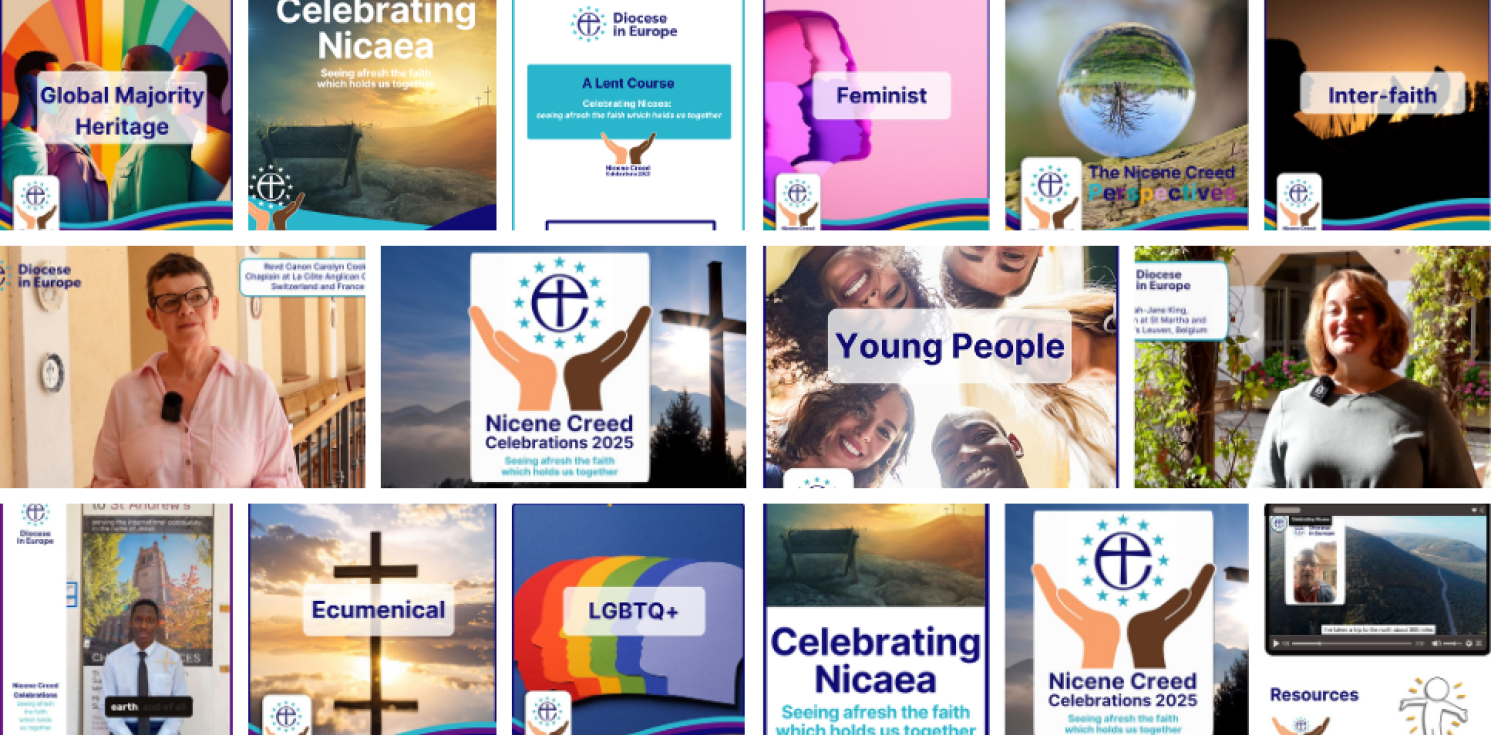
For those (many) for whom joining a pilgrimage wasn’t practical, the Lent Course developed under the leadership of Donald McFadyen provided another mode of engagement. ‘Seeing afresh the faith which holds us together’, the course provided groups in many chaplaincies opportunities to reflect together on what it means for Jesus Christ to be wholly human and definitely divine. The course invited participants to ask: How do you understand the Creed? What does it mean to you? How do you feel about it? How does it affect your life in the Church? Whilst it was designed as a ‘Lent’ course, the materials can be used at any time of the year, and I encourage your chaplaincy to do the course if you haven’t done so already.
We encouraged creative responses to the Creed, and one LGBT chaplain wrote a fine poem entitled ‘I love saying the Creed’. The Hymn to the Trinity by my predecessor Geoffrey Rowell is a wonderful musical response to the Creed, and many chaplaincies this year sung it on Trinity Sunday. It begins:
‘Light of light, Love’s radiant Glory
Blessed Trinity adored!
Well of life, our shaping story,
Source of beauty, life outpoured!’
People from different groups and backgrounds produced responses which are available on the diocesan website. Our chaplain in Bucharest describes how his chaplaincy’s response to the 1700th anniversary year had been to drop the filioque clause from their weekly recitation of the creed – with significantly strengthened ecumenical relationships with their Romanian Orthodox colleagues as a result. Our inter-faith officer, reflects on the Creed as a starting point for inter-faith dialogue. The opening line of the Creed - belief in one God - offers a meeting point for the monotheistic faiths, whilst subsequent and distinctively Christian lines can serve as jumping-off points for dialogue. Other contributors explore the significance of this opening line for our Care for Creation: our faith starts with the recognition of a God who in love and freedom creates the world and all that is in it.
Three women offer feminist and womanist readings and critiques of the Creed. They invite us to ask: does the Creed’s masculine language give a one-sidedly gendered view of God and does it occlude the experience of women? Contributions from LGBTQ people regret that the Nicene Creed doesn’t include more statements about love and the way Jesus showed us how to live and love. They express the desire that the Creed could express a unity that gathers in the widest diversity of human beings.
There are some really good responses from young people. One young person finds that the writers of the Creed were asking ‘Who is Jesus?’, ‘Where does he come from’, ‘How do we find our belonging with him?’, and observes that these are the same questions that young people today are asking. Another experiences the Creed as an expression of a historic, traditioned faith – offering to young people an invitation to belong and participate in God’s great story of salvation that transcends generations.
A Global Majority Heritage contribution critiques what some have seen as the imperialistic and colonial associations of the Creed. The contributor notes that genuine unity is not achieved by erasing difference but by learning to celebrate and live with it. There is a risk of a universal declaration flattening local cultures. It is all the more important that the Creed is translated into contextually authentic local languages. The author gives a suggestive reading of the Nicene Creed as a protest against domination, a pastoral balm for wounded memories and a mission manifesto calling the Church to embody God’s love in diversity, justice and reconciliation.
Over the year we held two inspiring ‘Bishop’s Study Days’, one led by Dr. Christian Hofreiter and the other by Dr. Graham Tomlin. They were both in different ways aimed at helping us have confidence in the faith articulated at Nicaea and to be more able to defend and commend it in secular contexts.
I want to express grateful thanks to all who have contributed to this range of creative work. I am thankful to those who have produced study materials, composed music, written personal responses, produced videos, shared their expertise and engaged with the theme in their chaplaincies. It is, of course, testament to the richness – indeed divine inspiration - of the Nicene Creed that it is capable of evoking such a wonderful array of thoughtful and moving responses.
We are now moving into the season of Advent. This draws us into the range of some of the elements of the Creed to which our materials have not so far attended: the Christ who will come again to judge the living and the dead; our belief in the resurrection of the dead and in the life of the world to come. In medieval tradition, the four Sundays of Advent have been devoted to the four last things evoked by the Creed: heaven, hell, death and judgement.
These themes remind us that in the statements we recite in the Creed we are not merely talking about theoretical abstractions concerning the nature of God. The Creed is important because it relates the story of God to our own story. We believe in the Son of God who ‘for our sake and for our salvation’ became human, lived on earth, died and rose again for us.
Moreover, how we respond to God’s revelation is of eternal significance. Each time we say the Creed we are invited to declare again our own personal belief and to claim again the salvation offered to us in Jesus Christ. The Creed embodies a succinct statement of who God is and what he has done to which we must respond. One day we will stand before the judgement seat of God to give an account of that response. A dangerous, divided and often cynical world needs people of confident and loving faith. In regard to matters of personal conviction and faith we cannot sit on the fence. Dante is often quoted as saying ‘the hottest places in Hell are reserved for those who, in a period of moral crisis, maintain their neutrality.’ So let us continue to declare the Nicene Creed with confidence and with joy. And let us live courageously as those who believe in the forgiveness of sins, the resurrection of the dead and the life of the world to come.
Robert Gibraltar in Europe